 See photos and updates from listings directly in your feed
 Share your favorite listings with friends and family
 Save your search and get new listings directly in your mailbox before everybody else
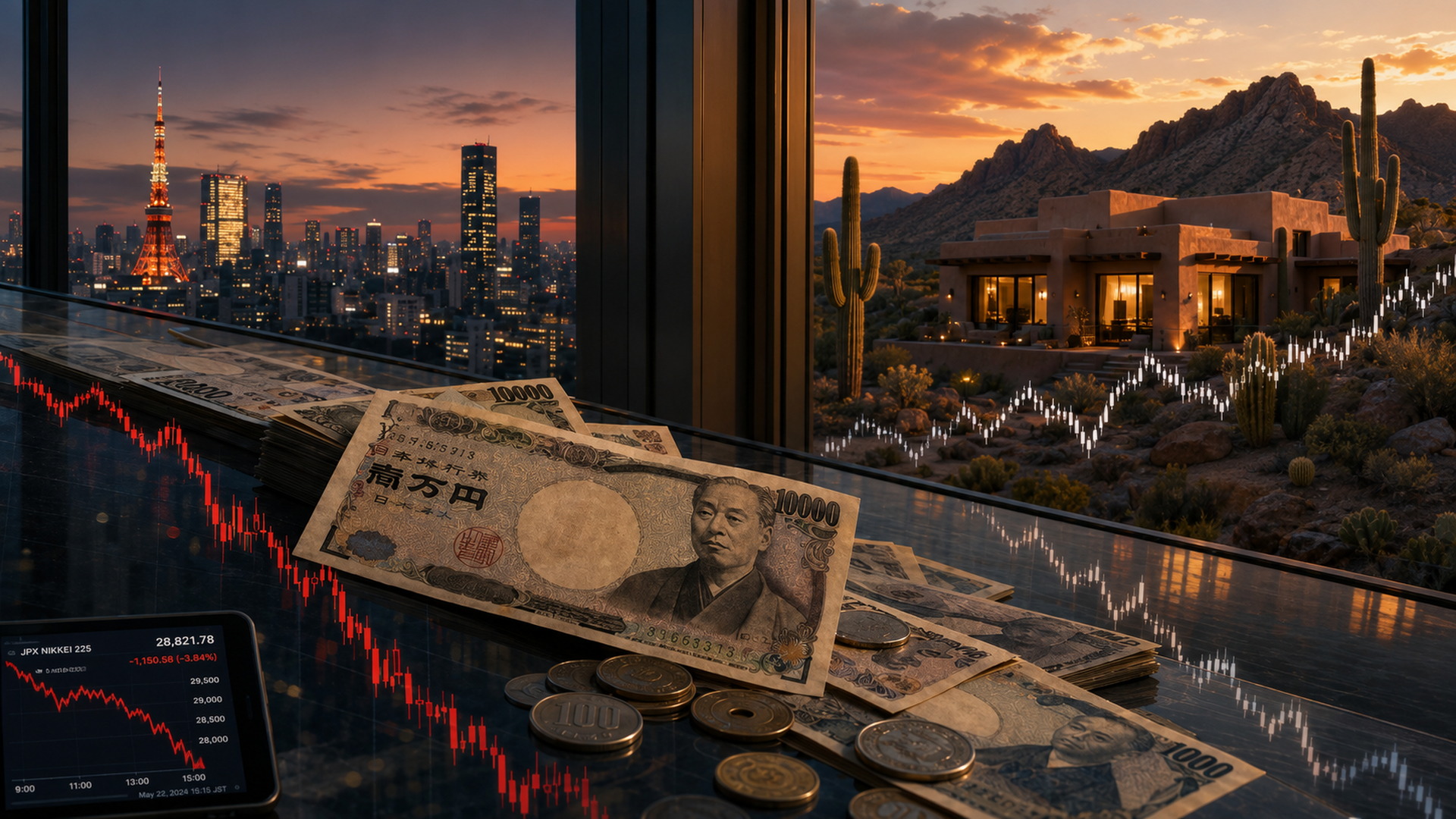
Every mortgage rate conversation in the Valley sounds the same right now. Buyers are waiting on the Fed. Sellers are waiting on the Fed. Local news is waiting on the Fed. It’s as if one meeting in Washington sets the price of every home from Old Town to Desert Mountain.
It doesn’t. And if you actually want to understand why Scottsdale and Metro Phoenix mortgage rates are stuck where they are and why a Fed rate cut may not save you as much as you think, you need to stop watching Washington and start watching Tokyo.
What’s unfolding in Japan right now is one of the most consequential forces working against American mortgage rates, and almost nobody in this market is talking about it. The buyers and sellers who understand it will make sharper decisions than the ones waiting on a Fed headline that may never deliver the relief they’re hoping for.
Two Things People Keep Confusing
The Federal Reserve controls the federal funds rate, the overnight rate banks charge each other. That number moves credit cards and home equity lines. It does not directly set your 30-year fixed mortgage rate.
Your mortgage rate tracks the yield on the 10-year US Treasury bond, and that yield is set by the global bond market, not by Jerome Powell’s successor, Kevin Warsh. When demand for US Treasuries is strong, yields stay low, and mortgage rates stay low. When big buyers step back, yields have to rise to attract new ones, and your rate rises with them.
The Fed is one voice in that room. It is not the only one. And the biggest voice currently walking toward the exit is Japan.
Why Japan Has Quietly Subsidized Your Mortgage for Decades
For nearly thirty years, Japan was the largest foreign holder of US Treasury debt, sitting near $1.2 trillion as of early 2026. That wasn’t generosity; it was arithmetic. Japan held interest rates near zero (sometimes below zero) for decades to jolt its economy back to life after the 1990s. With Japanese bonds paying almost nothing at home, Japanese life insurers, pension funds, and regional banks parked money in US Treasuries instead to chase higher yields.
The side effect for American homebuyers was steady, dependable foreign demand for US debt, which kept Treasury yields and mortgage rates lower than they otherwise would have been. Every Japanese institution buying a Treasury bond was, in effect, quietly subsidizing the rate on your mortgage.
That arrangement is unwinding, and it’s picking up speed.
What Changed, and Why It’s Hitting Now
Starting in 2024, the Bank of Japan began reversing decades of near-zero rates. Japanese 10-year government bond yields have climbed to 2.73%, a 28-year high, and the 30-year Japanese bond recently broke 4% for the first time ever.
Once Japanese bonds started paying real yields, the incentive to send money to America disappeared. Japanese institutions can now earn a competitive return at home, in their own currency, without the foreign-exchange risk of holding dollars.
The result is a historic pullback from US Treasuries. Japanese investors sold a net $29.6 billion in US government, agency, and municipal bonds in the first quarter of 2026 alone, the sharpest quarterly drop in nearly four years, and the pace has continued to accelerate month over month. As one portfolio manager at Federated Hermes put it, Japan is pulling a historically dependable buyer out of a US bond market already stretched thin by large federal deficits (Crypto Briefing; CNBC).
Japan still holds roughly $1.2 trillion in Treasuries. Even a partial repatriation of that money has real weight on US yields, and TD Economics has projected that Japan’s pullback alone could push 10-year Treasury yields 20 to 50 basis points higher over the medium term. A move of that size shows up directly in mortgage rates, corporate borrowing costs, and the cost of servicing the federal government’s debt (Fortune; Crypto Briefing).
The Carry Trade Makes This Worse
Layer on the yen carry trade. For years, investors around the world borrowed cheaply in yen, converted it to dollars, and bought higher-yielding US assets, including Treasuries, amplifying Japanese-linked demand for US debt well beyond direct institutional buying.
As the Bank of Japan raises rates and the yen strengthens, that trade reverses. Investors who borrowed yen to buy dollar-denominated assets now have to sell those assets, convert the proceeds back to yen, and repay the loan. That means more Treasury supply hitting the market with less demand to absorb it, and yields climb further. The American Enterprise Institute has warned that this carry-trade unwind is landing at an especially inconvenient moment, and that without a serious rethink of US budget policy, a meaningful rise in Treasury yields should be expected (AEI).
What This Means for Mortgage Rates in Scottsdale and Metro Phoenix
Here’s the honest read for anyone weighing a move in Scottsdale, Paradise Valley, North Phoenix, Cave Creek, or Carefree right now.
The story that mortgage rates will drop meaningfully once the Fed cuts is only half the picture. Even if Warsh’s Fed does eventually pivot, the 10-year Treasury yield that actually sets your rate is being pushed up by forces the Fed has no direct control over, and Japan’s exit from the Treasury market is structural, accelerating, and indifferent to what happens at any Fed press conference. Rising Treasury yields ripple outward: mortgage rates stay elevated, construction and development financing gets more expensive, and it puts more pressure on a federal budget already carrying a heavy interest bill (Asia Times).
Locally, that reality is already showing up in how this market behaves. Scottsdale is currently trading with meaningfully more breathing room than in the peak years: homes are taking roughly 60 days on average to sell, price growth has cooled to the low single digits year over year, and buyers are negotiating repairs and concessions again rather than waiving everything to compete. That’s not a market waiting on a rescue rate. It’s a market recalibrating to a rate environment that may simply be the new normal for a while.
For sellers, that means pricing to today’s comps, not 2021 memories and not banking on a rate-driven wave of new demand to bail out an ambitious list price. For buyers, it means the “wait for 5%” strategy is a bet on a chain of events a cooperative Fed, a reversal of Japanese repatriation, and a resolution to the US fiscal deficit that isn’t lining up anytime soon. What’s far more likely to persist is what we have now: mortgage rates parked in the mid-to-upper 6% range, a more patient buyer pool, and a market that rewards buyers and sellers who act on facts rather than waiting for a headline.
The One Thing to Remember
The Fed is not your mortgage rate. Your mortgage rate is global demand for US debt, and the most reliable buyer of that debt for three decades is packing up and heading home.
That’s the story nobody in real estate is telling you. Now you know it.
If you want to work through what it means for your specific buying or selling decision in Scottsdale or Metro Phoenix, that is the conversation we have every day.
(480) 318-5454 · vandykegroupaz.com
Griffin Realty Group serves Buyers and Sellers across Scottsdale and the Metro Phoenix Luxury Real Estate Markets.
If rates aren’t coming down the way you’ve been told to expect, what does that actually change about your next move in this market?