 See photos and updates from listings directly in your feed
 Share your favorite listings with friends and family
 Save your search and get new listings directly in your mailbox before everybody else
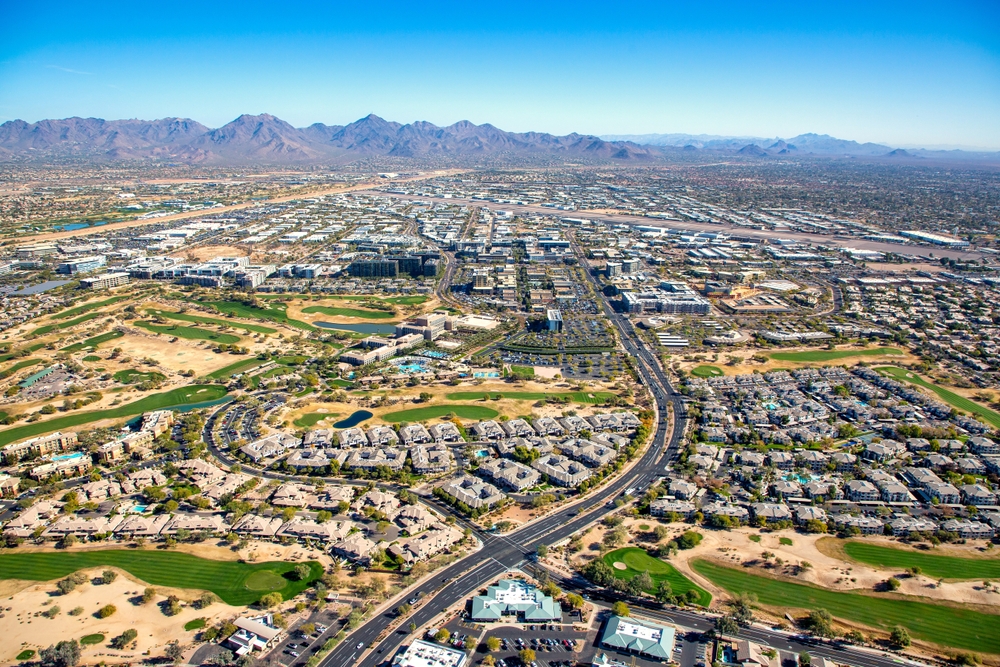
For nearly two years, anyone driving Loop 101 through north Scottsdale got used to barrier walls, lane shifts, and weekend closures timed around the WM Phoenix Open. That phase is over. ADOT and the City of Scottsdale have widened Loop 101 between Princess Drive/Pima Road and Shea Boulevard by one general-purpose lane in each direction, modified the interchanges along that stretch, and wrapped the final pavement work this spring.
It’s easy to read that as a traffic story. It isn’t. It’s an economic one, and if you own property between Shea and Princess, it’s a real estate story too. Arizona Dept of Transportation
What Was Actually Built and How Long It Took
The Loop 101 Improvement Project added a general-purpose lane in each direction across a 4.5-mile work zone, on top of turn-lane additions at the Shea Boulevard, Raintree Drive, and Princess Drive/Pima Road interchanges. The project broke ground in January 2024 and reached substantial completion in early 2026, with final surface work diamond grinding, restriping, and marking finished this spring. Total cost: $108 million, funded in part through the Proposition 400 sales tax Maricopa County voters approved back in 2004. acppubs.com
This wasn’t an isolated fix. It was the final segment of a 40-mile capacity plan ADOT has been executing for years, stretching from I-17 in north Phoenix to Loop 202 in Chandler. Unlike a bridge replacement, there was no detour, no reduced-lane purgatory stretching a decade just under two years of managed disruption before the corridor reopened at full new capacity.
Here’s the question worth asking now that it’s finished: what was this widening actually built for?
The Bigger Picture: Scottsdale Isn’t Growing in Isolation
This freeway work is landing at the same moment the broader Phoenix economy is being reshaped by a wave of capital that dwarfs almost anything else happening in U.S. manufacturing right now. Taiwan’s clearance of TSMC’s $20 billion Arizona capital injection is pulling suppliers, engineers, and skilled trades into the north Valley. Phoenix’s industrial market has shifted from an e-commerce distribution story to a semiconductor and data-center supply-chain story, with suppliers to companies like TSMC and Intel establishing operations across the metro. Colliers
None of that activity is happening in Scottsdale proper. But Scottsdale doesn’t need it to. What Scottsdale offers is what every high-earning engineer, executive, and relocating founder in that ecosystem wants once the paycheck clears: proximity without the commute penalty. A freed-up Loop 101 is exactly the kind of unglamorous infrastructure that makes that proximity real.
What This Means for Scottsdale Real Estate
The corridor’s luxury communities Grayhawk, DC Ranch, McDowell Mountain Ranch, Silverleaf, and Desert Mountain sit directly on this stretch of the 101. For buyers in those neighborhoods, the freeway isn’t scenery. It’s the on-ramp to everywhere else in the Valley.
Highway capacity has a well-documented relationship to housing demand: when highways expand and transportation corridors improve, it creates the physical capacity for growth, and demand typically follows job-creating infrastructure within twelve to thirty-six months. We’ve watched a version of this play out already with the Cardinals’ Paradise Ridge facility and its ripple effect on this same cluster of communities. The 101 widening is a quieter catalyst, but a more durable one; it doesn’t depend on a franchise’s decisions. It depends on concrete that’s already poured and open to traffic.
Institutional capital is already circling the same geography. Three fully stabilized Class A office buildings spanning the East Valley, Scottsdale Airpark, and Central Phoenix recently came to market as a test of institutional appetite a signal that sophisticated money is watching this corridor closely, not just retail buyers.
For sellers in the Shea/Princess/Pima corridor, the disruption years are behind you, and the access story is genuinely better than it was eighteen months ago. For buyers relocating for tech and semiconductor-adjacent roles, north Scottsdale just became a more competitive alternative to living closer to the North Phoenix job sites without giving up the mountains, the golf, or the school districts that brought them here in the first place.
The Long View
Buyers thinking about Scottsdale real estate on a ten-year horizon, which is exactly the right way to think about it, should see this project for what it is: unglamorous, voter-funded infrastructure that quietly removed one more friction point between north Scottsdale and the fastest-growing manufacturing economy in the country.
Better freeways mean more reliable access. More reliable access means a wider buyer pool. A wider buyer pool means sustained demand for a supply of desirable properties that, by definition, cannot grow. The communities closest to the corridor stand to feel that first.
For buyers and sellers navigating this moment, the tool that matters isn’t the ADOT press release; it’s an agent who understands what this means, property by property, price point by price point, corridor by corridor.
That’s the conversation we’ve been having with clients since this project broke ground. If you want to have it too, you know where to find us.
480-315-5454 · grantvandyke.com
Griffin Realty Group serves buyers and sellers across Scottsdale and MetroPhoenix luxury real estate markets.